
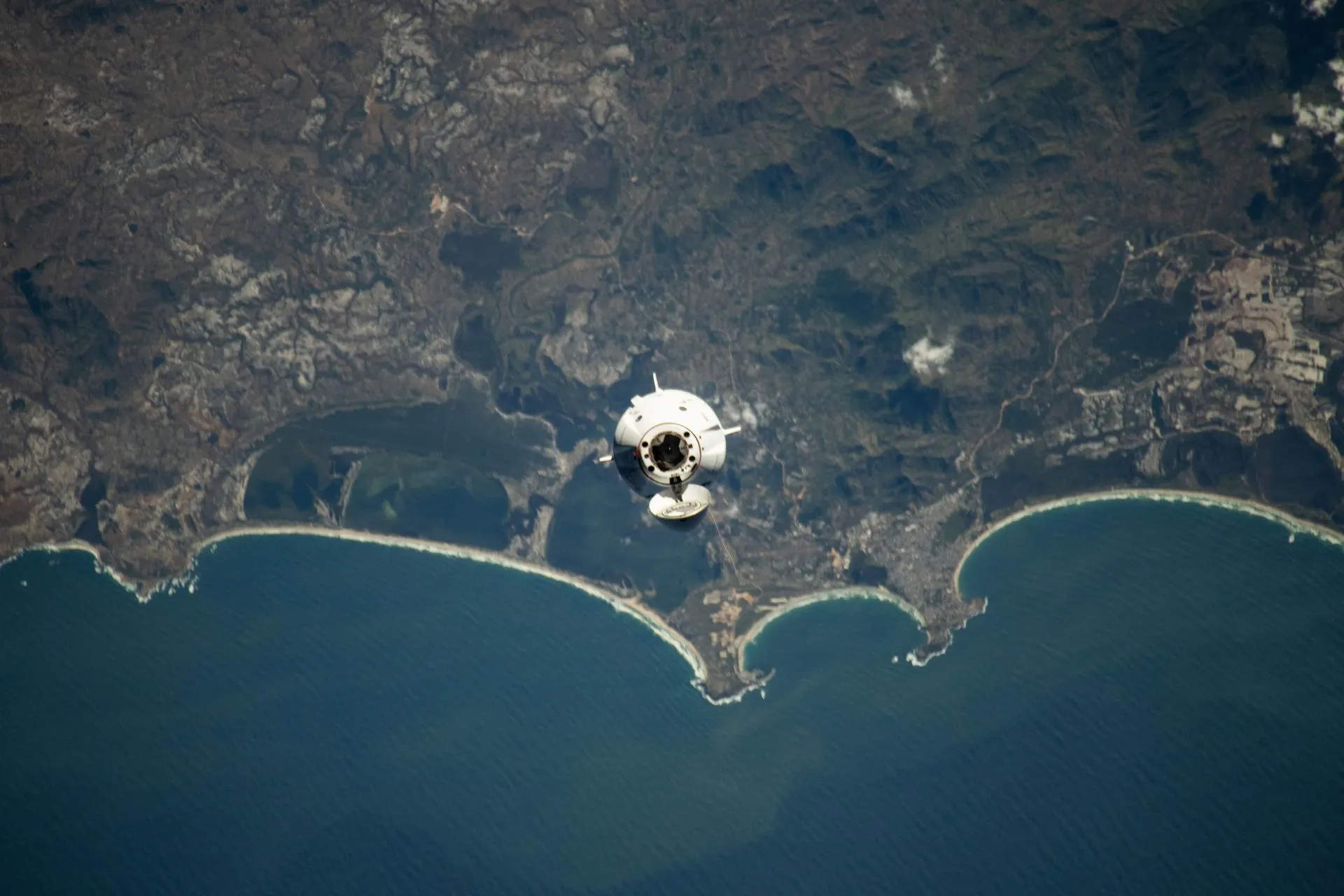
Axiom Mission 4 crew receives go to undock Monday for final ISS biomedical and nanomaterials research ahead of July 15 splashdown.
Axiom Mission 4 Crew Poised to Undock Monday for Final Research and Return
At a Glance on “Axiom Mission”
- Mission Control approves undocking Monday, July 14 at 7:05 a.m. EDT from Harmony module
- Crew complete vital biomedicine, nanomaterials, and food-source science on ISS
- Commander Peggy Whitson and pilot Shubhanshu “Shuks” Shukla lead a busy, 15-day mission
- Four ISS astronauts conduct 60+ experiments, including Indian microgravity studies
- Undock timing aligns with splashdown July 15 off California coast
- ISRO-NASA-Axiom collaboration celebrates Shukla’s historic return as only the second astronaut from India
Undocking Scheduled Monday Morning
Mission managers across NASA, Axiom Space and SpaceX confirmed the Ax 4 crew will undock from the ISS on Monday, July 14. Undocking from the station’s space facing port on the Harmony module begins at 7:05 a.m. EDT. Hatch closure starts at 6:45 a.m. Crew members will board the Dragon spacecraft ahead of spacecraft extraction from ISS docking hardware.
High Impact Science Near Mission End
Final research includes collection of blood samples, micro algae investigations, nanomaterials tasks exploring wearable health monitors. Saturday research wraps electrical muscle stimulation trials and thermal comfort experiments in exercise suits. Sunday activities focus on packing personal cargo and science gear in Dragon. NASA engineers monitor these tasks and assist crew in securing research materials.
NASA Engineers Ensure Smooth Ops
NASA flight engineers support crew throughout science and hardware tasks. Nicole Aiers handles centrifuge based blood sample spinning and storage. McClain focuses on undocking gear and science activity oversight. JAXA commander Takuya Onishi records saliva data and inspects equipment for the airlock. Roscosmos engineers monitor the exercise sessions of the crew, as well as hardware preparations for the robotic arm.
Indian Pilot Shukla Concludes Historic Mission
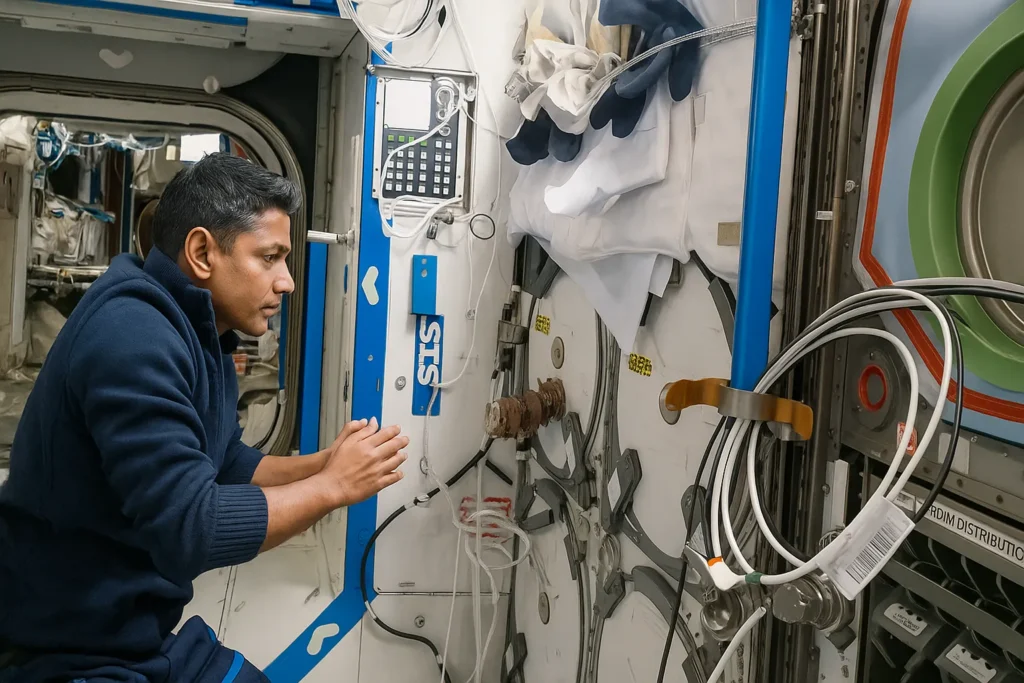
Pilot Shubhanshu “Shuks” Shukla marks a historic moment in Indian spaceflight as a member of the first Indian astronaut group on the ISS. He launched from Kennedy Space Center on June 25, docked on June 26, and will return via splashdown on July 15 in the Pacific Ocean. ISRO plans a series of medical and psychological evaluations after the flight, spanning seven days.
Extensive Indian Microgravity Research
Shukla led seven India specific experiments during the mission. These include tardigrade resilience studies, muscle cell myogenesis, germination studies for sustainable space crops, cyanobacteria life support research. Additional nano algae and seed based food source trials are in progress and scheduled to return aboard Dragon for analysis.
Dragon Readies for Return with Over 580 lbs of Cargo
Aboard Dragon, over 580 lbs of cargo includes science data, hardware, blood and saliva samples. Dragon is scheduled to undock July 14 and splash down off California coast July 15. NASA will be providing live mission coverage through NASA+ starting at 4:30am EDT. Axiom and SpaceX will continue to live stream around undocking and reentry.
Global Outreach and Media Engagement
The crew will appear live on CNN International after undocking Monday at 4pm EDT. ISS-based outreach engaged global audiences with school children in India observing the station pass overhead. Students recorded questions for Shukla. Indian NGO Life To And Beyond and Kolash High School students followed mission milestones, highlighting STEM inspiration.
ISRO–NASA–Axiom Partnership Strengthens International Ties
AX 4 marks a milestone in international collaboration between ISRO, NASA and Axiom Space. Shared science projects and in orbit studies support continued cooperation leading into India’s Gaganyaan program and potential domestic space station. President Modi and the U.S. President have endorsed the partnership, marking strong diplomatic support.
Deep Space Commercial Strategy in Action
NASA’s reliance on commercial crew and partnership missions like AX 4 supports low Earth orbit science while enabling focus on deeper objectives like Artemis lunar missions. Commercial access to ISS through Axiom enables broader international access and revenue generating science and outreach capabilities.
Educational Impact and Future Astronaut Careers
AX 4 inspired secondary students across India to view ISS and follow Shukla’s mission. Teacher led workshops introduced space science labs to rural classrooms. Students expressed awe at India’s growing space capabilities, and call-out for stronger STEM infrastructure emerged in light of mission achievements.
Countdown to Splashdown After 60+ ISS Experiments
After fifteen days and over 60 science tasks completed, the crew prepares for return. Undocking Monday begins Dragon’s autonomous sequence. Splashdown is expected off California coast July 15. Crew will transfer to post flight rehabilitation under ISRO and NASA physician oversight.
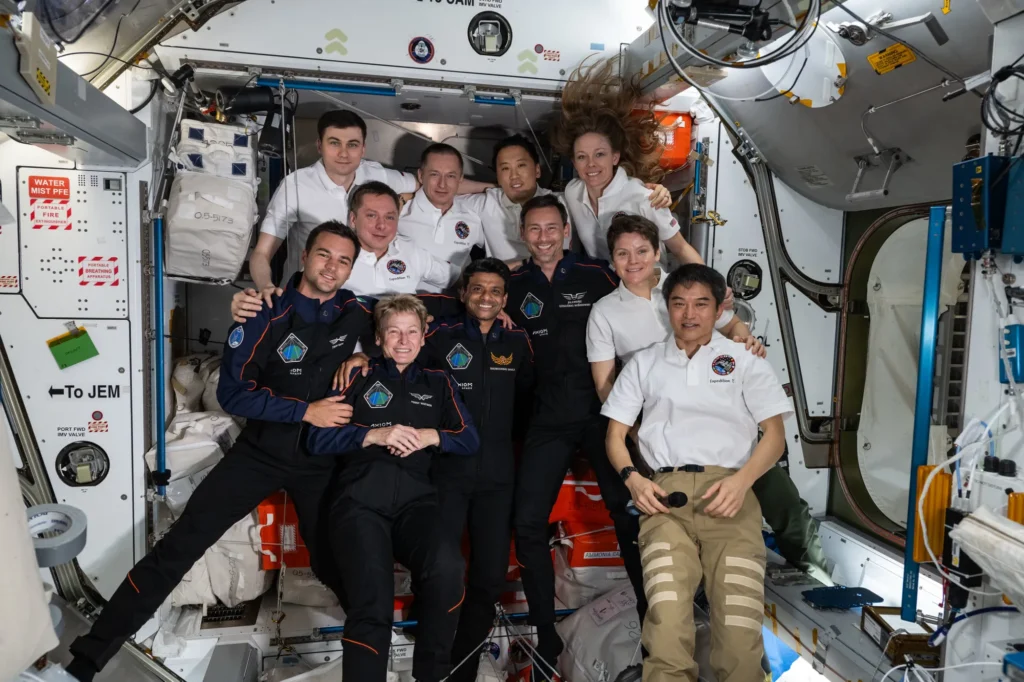
The Axiom Mission 4 and Expedition 73 crews join together for a group portrait inside the International Space Station’s Harmony module. In the front row (from left) are Ax-4 crewmates Tibor Kapu, Peggy Whitson, Shubhanshu Shukla, and Sławosz Uznański-Wiśniewski with Expedition 73 crewmates Anne McClain and Takuya Onishi. In the rear are, Expedition 73 crewmates Alexey Zubritskiy, Kirill Peskov, Sergey Ryzhikov, Jonny Kim, and Nichole Ayers.
Credit: NASA
Final Mission Overview
Axiom Mission 4 marks success of private NASA ISRO collaboration, blending cutting edge science and historic astronaut milestones. Monday’s undocking paves way for return of data, biological samples and research hardware. The mission advances deep space readiness, STEM outreach and Indian spaceflight ambition. Global eyes follow Shukla’s homecoming and record of scientific discovery.
Axiom Mission 4 crew to undock Monday, July 14 at 7:05 a.m. EDT after completing 60+ ISS experiments. Indian pilot Shubhanshu Shukla makes historic return on July 15 off California. Mission highlights biomedical, microgravity science and international collaboration.