
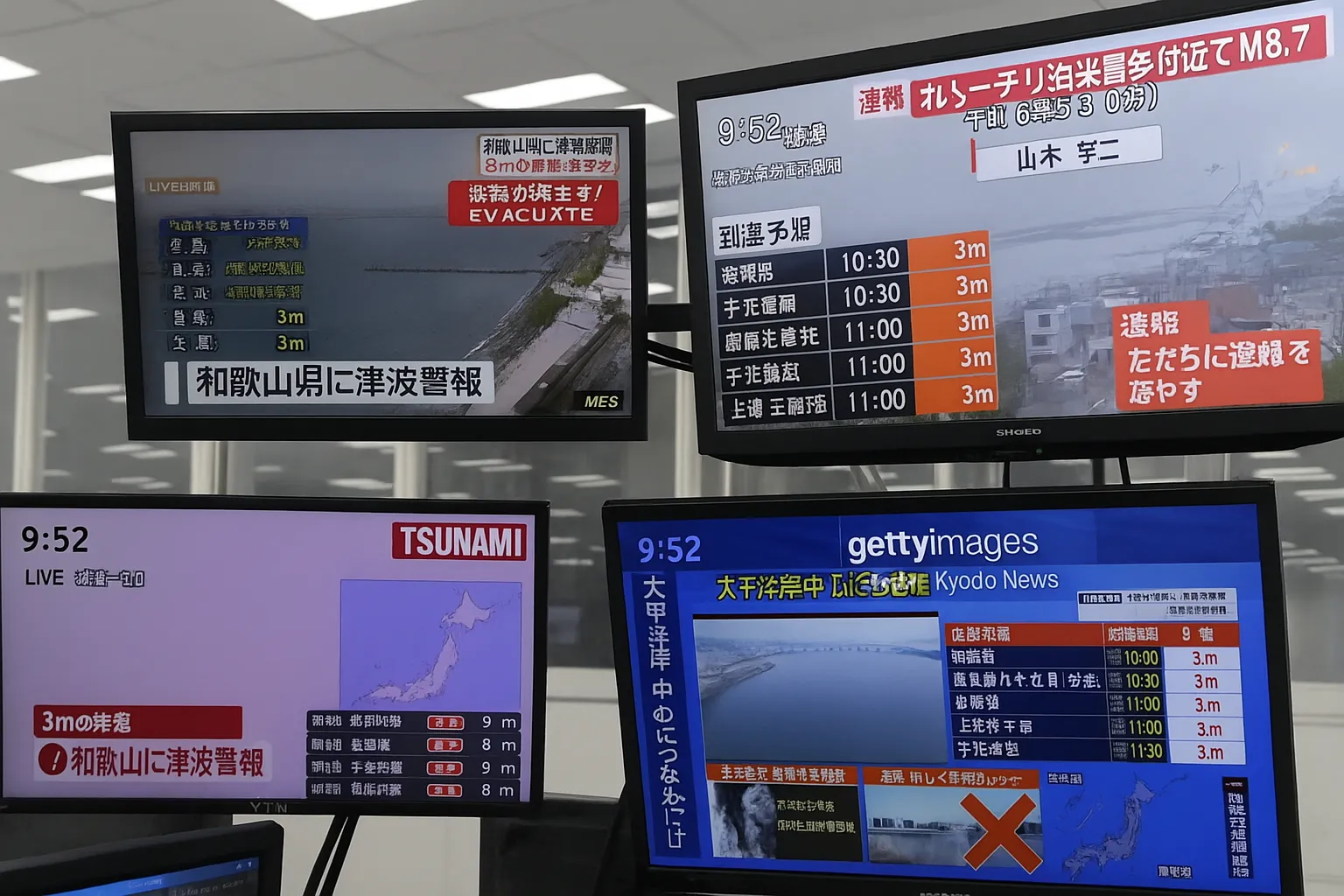
A tsunami crisis hits Japan and Russia after an 8.8 earthquake, with warnings issued for Hawaii, Alaska, and California. Evacuations are underway.
The Earthquake: A Beast in the Pacific Rim
On July 30, 2025, an 8.8 magnitude earthquake occurred off near Russia’s Kamchatka Peninsula, triggering a tsunami emergency across the Pacific. Tsunami waves up to 13 feet slammed Russia’s Kuril Islands and Japan’s Hokkaido, prompting urgent evacuations. Warnings now stretch from Hawaii to Alaska, California, and as far south as New Zealand. Sirens rang in Honolulu and residents sprinted to high ground while many coastal towns in Japan braced for larger waves. This blog explores the tsunami crisis’s scope, the earthquake’s devastation, and the race to protect millions across the Pacific.
Earthquake Details
The tsunami emergency began at 08:25 hours Japan time, July 30, 2025 – when a shallow 8.8 magnitude earthquake occurred along the seafloor 74 miles east-southeast of Petropavlovsk-Kamchatsky, Russia. The US Geological Survey (USGS) originally announced it to be an 8.0 magnitude, but later did upgrade it, indicating a depth of only 12 miles; a perfect scenario to trigger a tsunami. There were many strong aftershocks, which worsened the nerves of the badly shaken local officials, to include a 6.9 magnitude quake.
Russia’s Kamchatka Peninsula, part of the volatile “Ring of Fire,” bore the brunt. In Petropavlovsk-Kamchatsky, residents fled without shoes as cabinets toppled, mirrors shattered, and balconies swayed, per Russia’s TASS news agency. Power outages and mobile service failures compounded the chaos. Kamchatka’s governor, Vladimir Solodov, called it “the strongest quake in decades.” The Russian Academy of Sciences noted it’s the most powerful since a 9.0 quake in 1952.
Tsunami Crisis Unfolds: Waves Hit Russia and Japan
As the tsunami emergency began with waves up to 13 feet crashing into Russia’s Kuril Islands, flooding Severo-Kurilsk’s port and a fish processing facility according to Russia’s Emergency Ministry. People evacuated to high ground and reports so far there is no serious injuries. In Japan, the Meteorological Agency measured 1.3-foot waves from 16 locations along Hokkaido’s Pacific coast, from Nemuro to a location northeast of Tokyo. Larger waves—up to 10 feet—are feared, prompting sirens and evacuation orders.
Japan’s public broadcaster NHK showed residents on Hokkaido rooftops, sheltering under tents as fishing boats fled ports. The 2011 Fukushima disaster looms large, and workers evacuated the Fukushima nuclear plant as a precaution, though operator TEPCO reported no abnormalities Chief Cabinet Secretary Yoshimasa Hayashi said no injuries or significant damage had yet been confirmed in Japan but urged people stay on guard.
Tsunami Impact Overview
| Region | Impact Details |
| Russia (Kuril Islands) | 13-foot waves flooded Severo-Kurilsk port and fish processing facility |
| Japan (Hokkaido) | 1.3-foot waves recorded, up to 10-foot waves feared, evacuations underway |
| Hawaii | Tsunami warning, first waves expected at 7:17 p.m. HST, up to 10 feet possible |
| Other Regions | Advisories for Alaska, California, Oregon, Washington, Chile, New Zealand, Ecuador |
Pacific-Wide Alerts: Hawaii, Alaska, and Beyond
The tsunami crisis spans the Pacific. Hawaii’s under a full tsunami warning, with sirens sounding in Honolulu at 3:23 p.m. HST. The Pacific Tsunami Warning Center (PTWC) predicts first waves around 7:17 p.m. HST, potentially reaching 10 feet. Governor Josh Green signed an emergency declaration, urging residents to reach high ground or the fourth floor of buildings. Mayor Rick Blangiardi stressed, “If you’re safe, stay there. If not, get to higher ground now.”
The National Tsunami Warning Center issued advisories for California, Oregon, Washington, and British Columbia, expecting waves from 1 to 5 feet Additionally, Alaska’s southern coast and the Aleutians are all warned. The PTWC warned of possible 3- to 10-foot waves in Chile, the Solomon Islands, and Ecuador, with New Zealand anticipating “strong and unusual currents.” The tsunami crisis could linger for hours, as waves travel at jet-like speeds in deep water, piling up near shores.
Why This Tsunami Crisis Is So Dangerous
Tsunamis aren’t just one wave—they’re a series of powerful surges, per Dave Snider of the National Tsunami Warning Center. “They can travel hundreds of miles per hour in deep water, slowing and stacking up near coasts,” he told Reuters. This tsunami crisis threatens widespread flooding, with debris amplifying destruction. The shallow depth of the earthquake, its nearness to land, and its extremely powerful 8.7 magnitude is particularly lethal. 8.7 is one of the most powerful earthquakes since Japan’s 9.0 earthquake in 2011.
The Ring of Fire, where tectonic plates collide, fuels this volatility. Kamchatka and Japan are no strangers to quakes, but this event’s scale is rare. A week ago, there were five earthquakes there, the largest being 7.4, and a 7.3 quake in ada earlier this month. The 1952 Kamchatka quake, also 9.0, caused 30-foot waves in Hawaii but no deaths. This time, the tsunami crisis’s reach is broader, with millions at risk.
Ground Realities: Chaos and Evacuations
In Russia, the tsunami crisis sparked panic. A Petropavlovsk-Kamchatsky resident, Yaroslav, 25, described to TASS, “The shaking started slow but lasted three minutes. The building felt fragile, like the walls could collapse.” Some residents were injured fleeing, one jumping from a window. A new airport terminal reported injuries, and a kindergarten in Severo-Kurilsk was damaged, though most buildings withstood the quake.
Japan’s coastal towns, where the disaster happened in 2011, acted quickly. NHK footage showed fishing boats racing to sea to avoid shallow-water waves. Residents climbed to the rooftops of their homes in fear of aftershocks. Evacuations are underway in sakhalin and emergency services are highly taxed. The tsunami crisis has uprooted power and communications, and recovery or rescue has become more difficult.
Global Response and Warnings
The tsunami crisis has provoked proactive global responses. President Trump posted on social media, “Stay strong and stay safe!” urging vigilance. The US National Weather Service warned against visiting beaches for photos, noting risks to residents and rescue teams. New Zealand’s emergency agency advised avoiding coasts, harbors, and rivers, despite being 6,000 miles from the epicenter.
The PTWC cautioned that tsunami waves can wrap around islands, putting all shores at risk. “The first wave might not be the biggest,” the PTWC mentioned, adding that they can “continue for about a day.” Hawaii’s emergency plans, refined through previous tsunamis, feature well-marked evacuation routes and siren systems. California’s Bay Area is under a tsunami advisory, with northern communities on higher alert.
Can the Tsunami Crisis Be Contained?
The containment of the tsunami crisis is dependent on time and preparedness. Hawaii has an established warning system with sirens and evacuation orders to circumvent loss. Japan’s preparation in response to 2011’s disaster has improved response with rapid evacuations and protections at the nuclear plants. In Russia’s remote Kamchatka territory, there are logistical difficulties, but evacuations to high ground have begun.
That said, the scale of the tsunami crisis is daunting. Waves could continue for hours, and tremors (as already seen at 6.9), could prompt additional waves. The forecasted models from the PTWC display varying predictions of wave height, and the current and accompanying debris are unpredictable. Coastal communities cannot let down their guard, especially international coordination when there are large distances to cover like in Chile and New Zealand.
The Human Toll: Fear and Survival
The tsunami crisis is a human story of fear. In Kamchatka some residents like Yaroslav left for safety from flimsy buildings, while evacuees in Japan still remember 2011. Honolulu’s residents, facing evening waves, are relocating with urgency A Kamchatka official, Sergei Lebedev, shared with TASS, “People are safe on high ground, but we’re not out of the woods yet.” The tsunami crisis is putting communities to the test, especially those already shaken by recent earthquakes.
Tsunami Global Crisis
The tsunami crisis triggered by an 8.8 magnitude earthquake off the coast of Russia’s Kamchatka Peninsula poses a serious threat to millions across the Pacific. Waves reaching up to 13 feet have already struck Russia and Japan, while Hawaii, Alaska, and California remain on high alert. Evacuations are proving to be lifesaving, but the situation could drag on for hours, with aftershocks and unpredictable waves still a concern. The unpredictable nature of the Ring of Fire underscores the critical importance of having robust warning systems and fostering international cooperation. As communities brace for impact, the tsunami crisis reminds us of nature’s power and humanity’s resilience. A tsunami crisis follows an 8.8 earthquake near Russia, hitting Japan and threatening Hawaii, Alaska, and California. Evacuations are urgent.